
Steve Farmer – Predict & Profit: Automated Prediction Market Trading with Python
Everyone else is guessing. You’ll have the real numbers.
Right now, hundreds of weather contracts are trading on Kalshi. Temperature highs, lows, precipitation. Thousands of dollars changing hands every day. And nearly every trader is pricing these contracts based on gut feel, Weather Channel headlines, or vibes.
What if you could see the actual probabilities before you trade?
How the bot knows the real odds (and why regular weather forecasts won’t cut it)
When you check the weather on your phone, you get one number: “High of 82°F tomorrow.” That’s a single forecast from a single model run. A best guess. But it tells you nothing about confidence. Is 82°F a lock, or could it just as easily be 78°F or 86°F?
The GFS ensemble model works differently. Instead of running one simulation, it runs 31. Each run starts with slightly different initial conditions (tiny variations in temperature, pressure, and humidity measurements) and lets the physics play out independently. You end up with 31 separate forecasts for the same location and the same day.
Here’s where it gets powerful for trading prediction markets.
Say Kalshi has a contract: “Will the high temperature in Chicago exceed 80°F tomorrow?” and it’s trading at 45 cents (implying 45% probability). You pull the 31 ensemble runs, and 23 out of 31 say yes, the high will exceed 80°F. That’s a 74% probability. The market says 45%. The ensemble says 74%. That 29-point gap is your edge.
You can’t get this from a regular weather API. NOAA, Weather.com, and AccuWeather give you a single forecast. The ensemble gives you a probability distribution, which is exactly what you need to compare against a prediction market price.
The bot pulls this ensemble data from a free public API (no key required), calculates the real probability for every active Kalshi weather contract, and flags the ones where the market has it wrong.
Built in a weekend. 5x return in the first week.
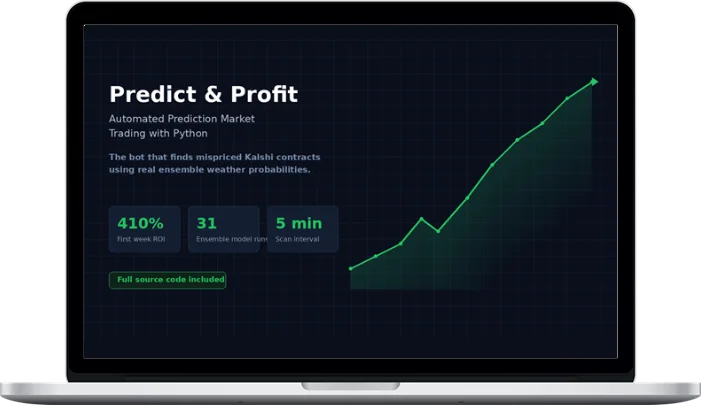
I built this system in a single weekend and started trading with it immediately. In the first week, it generated a 410% return on my starting capital. Not with some massive bankroll. With a small test balance, proving the concept with real money on real markets.
The edge is small on any single contract, but the bot scans every active weather market every 5 minutes, finds the best opportunities, and compounds those small edges into consistent returns.
This is the exact code I use. Not a watered-down tutorial version. The real thing.
What You’ll Learn In Predict & Profit: Automated Prediction Market Trading with Python
Complete Python source code for an automated trading bot that:
- Scans every active Kalshi weather market every 5 minutes
- Pulls real probabilities from the GFS 31-member ensemble (free API, no key needed)
- Compares ensemble probabilities to market prices to find mispriced contracts
- Scores opportunities on 4 factors: spread size, volume, order book imbalance, and probability edge
- Ranks all opportunities by composite score so you always see the best trade available
- Analyzes order book depth before placing trades
- Manages risk automatically: daily loss limit, per-series exposure cap, minimum score thresholds, penny contract filter
- Logs every scan, decision, and trade for full auditability
Complete setup guide and strategy walkthrough covering:
- Kalshi account and API key setup
- One-command environment setup (runs on your laptop or a $5/month cloud server)
- Database setup: works with SQLite out of the box (zero config) or Postgres for power users
- Every configuration parameter explained with recommended starting values
- Paper trading walkthrough so you can validate the edge before risking a dollar
- The math behind the 4-factor scoring system
- Parameter tuning guide: how to adjust thresholds as you learn
- How to read the bot’s output, interpret the logs, and spot good trades
- Notes on extending the bot to Polymarket and Interactive Brokers ForecastTrader
More courses from the same author: Steve Farmer
Related products
Forex Trading
Simpler Trading Indicators (TOS) – PinPoint Indicators + MultiSqueeze + MTF + HOLB + LOHB
Forex Trading
Sheridan Options Mentoring – “Battle Tested” SPX 15-Day Calendar On-Demand Short Course

Forex Trading
Forex Trading
Forex Trading

Forex Trading